
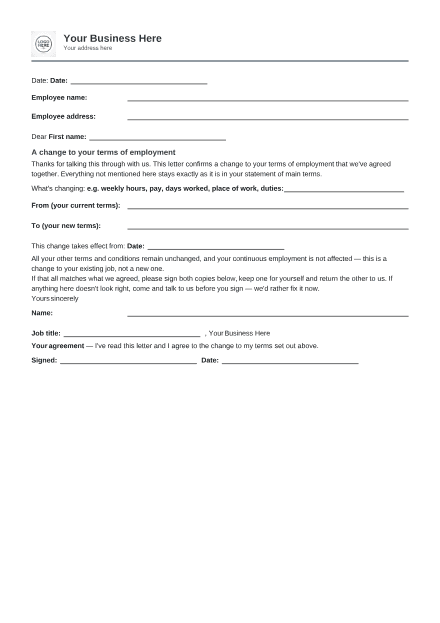
Variation of terms letter
Confirm an agreed change to someone's employment terms.
£7 inc. VAT — yours forever, no subscription.Or get it in the HR Essentials pack — £39.
Type your business name and the preview updates in seconds — the real PDF, editable on screen or printable to fill in by pen. Nothing about your business leaves your browser.
What you need to know
The plain-English guidance that comes with this document.
- You need their agreement — you can't just impose it. An employment contract can't normally be changed by one side alone. Talk the change through, reach agreement, and confirm it in writing (that's what this letter does, with the employee signing to accept). Imposing a change without agreement risks a breach of contract claim, an unlawful deduction claim if it cuts pay, or a resignation-and-constructive-dismissal claim.
- Steer well clear of "fire and rehire". Dismissing someone for refusing a change and re-engaging them on new terms is legally dangerous and getting more so. Right now it's a genuine last resort governed by a statutory Code of Practice — ignore the Code and a tribunal can add 25% to any award. And from January 2027 the Employment Rights Act 2025 goes further: dismissing someone for refusing a "restricted variation" (things like a pay cut, changed hours, less leave or different shifts) becomes automatically unfair, save for a narrow genuine-financial-survival exception. The safe route, by far, is agreement.
- Put the detail in, not just "your hours are changing". Spell out the old position and the new one, and the date it starts. Vague variation letters cause arguments later about what was actually agreed. Because a change to the main terms must be reflected in the written statement, this letter effectively updates it — keep it with their statement of main terms.
- Say why. A one-line reason ("to cover the new Saturday opening", "at your request, to fit around school hours") is worth having on the record. If a change is ever questioned — for discrimination, say — being able to show the genuine business reason, written at the time, is your best answer.
- Mind the knock-on effects. A change to hours or pay can ripple into holiday entitlement, overtime, pension contributions and sick pay. Check those before you confirm, so the new terms actually hang together.
- A trial period can break a deadlock. If someone's unsure, agreeing a temporary trial of the new arrangement — clearly stated as a trial, with a review date — is often a fairer, calmer way forward than forcing a yes/no. The letter has a line for exactly that. Be clear what happens at the end: back to the old terms unless you both agree to keep the new ones.
- Watch for discrimination and consistency. Be careful that a change doesn't fall harder on one group — for example, cutting or fixing hours in a way that disadvantages people with caring responsibilities could be indirect discrimination. Apply changes consistently and be ready to explain the business reason.
- Applies UK-wide. The need for agreement, and the fire-and-rehire rules, apply across Great Britain; Northern Ireland sets its own employment law, so if you're in NI check whether the same reforms apply there and when.
Please note: This is a template for guidance only. Adapt it to your business and check it against current law and your insurance requirements. It is not legal advice.