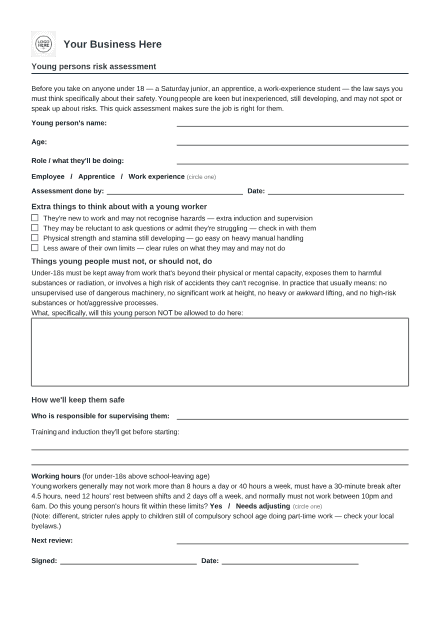
Young persons risk assessment
Before you take on anyone under 18 — the safety check the law expects first.
£7 inc. VAT — yours forever, no subscription.Or get it in the Safety at Work pack — £34.
Type your business name and the preview updates in seconds — the real PDF, editable on screen or printable to fill in by pen. Nothing about your business leaves your browser.
What you need to know
The plain-English guidance that comes with this document.
- It's a legal must, and it comes before they start. The Management Regulations require a specific risk assessment for a young person (under 18) before they begin work, taking account of their inexperience and immaturity. If you employ young people regularly for the same kind of role, one good assessment for the role can cover it — but review it for anyone whose situation is different.
- If it's under-16, tell the parents. Before a child under the minimum school-leaving age starts (including work experience), you must give the parent or guardian the key findings of the risk assessment and the control measures. Under-16s also fall under local authority byelaws with tighter limits on hours and types of work — check with your local council.
- Supervision is the main control. The single biggest protection for a young worker is a named, capable person keeping an eye on them, especially early on. Pair them up, check in often, and make it genuinely easy for them to ask "is this right?" without feeling daft.
- Keep them away from the sharp end. No unsupervised dangerous machinery, no serious work at height, no heavy manual handling, no high-risk chemicals or hot processes. Apprentices may progress to more as they're trained and assessed as competent — but that's earned step by step, not assumed on day one.
- Mind the hours. Over school-leaving age but under 18, the limits are real: normally no more than 8 hours a day / 40 a week, no averaging, longer rest breaks, and no night work in most cases. These are stricter than for adults and easy to breach on a busy weekend — build the rota to fit.
- It links to your other assessments. A young person's exposure to manual handling, substances (COSHH), noise or vibration should be looked at through this lens too — they may need lower limits or to be kept out of it entirely.
- Applies UK-wide. The duty applies across Great Britain (HSE) and Northern Ireland (HSENI). Working-time limits for young workers and the rules for school-age children apply UK-wide, with local byelaws setting the detail for children.
Please note: This is a template for guidance only. Adapt it to your business and check it against current law and your insurance requirements. It is not legal advice.