
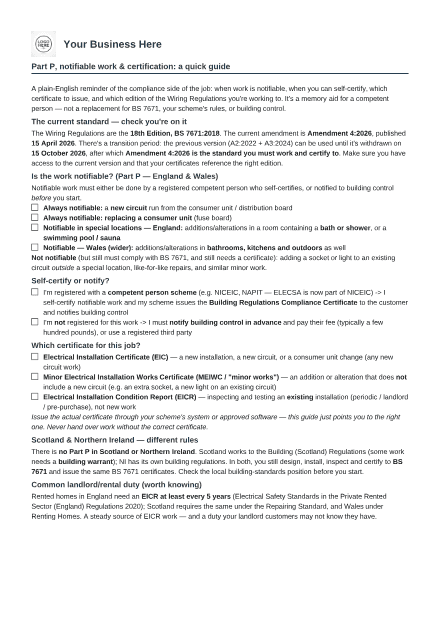
Part P, notifiable work & certification guide
What's notifiable, which certificate, which edition — the compliance backbone.
£14 inc. VAT — yours forever, no subscription.Or get it in the Electrician pack — £34.
Type your business name and the preview updates in seconds — the real PDF, editable on screen or printable to fill in by pen. Nothing about your business leaves your browser.
What you need to know
The plain-English guidance that comes with this document.
- This is the compliance backbone of the pack — the bit that keeps you legal, not just safe. Doing good electrical work is one thing; notifying the right work, self-certifying properly and issuing the correct certificate is what keeps you the right side of the Building Regulations and your scheme. This one-pager keeps it all in view so nothing gets missed on a busy job.
- Get the notifiable/non-notifiable line right — it's where people slip up. A new circuit and a consumer-unit change are always notifiable; so is much bathroom work. Do notifiable work without being registered and without telling building control, and you've technically breached the Building Regulations — which can bite when the customer comes to sell the house and has no certificate. When in doubt, treat it as notifiable.
- Self-certification is the reason scheme membership pays for itself. Being registered with a competent person scheme (NICEIC, NAPIT and others) lets you self-certify notifiable work and issue the Building Regulations Compliance Certificate, instead of paying building control a few hundred pounds per job and waiting for their inspection. If you do notifiable work regularly and aren't registered, the maths usually favours joining.
- Match the certificate to the work — EIC, minor works, or EICR. New circuit or consumer unit → EIC. Addition/alteration with no new circuit → minor works. Testing an existing installation → EICR. Issuing the wrong one (or none) is a common failing that undermines otherwise good work. Issue it through your scheme's software — this guide doesn't replace the official forms, it just tells you which to reach for.
- The standard is changing right now — don't get caught out. Amendment 4:2026 was published in April 2026 and becomes the standard you must certify to from 15 October 2026. During the transition either version is acceptable, but make sure you have the current amendment and that your certificates cite the right edition. Working to a withdrawn standard is exactly the kind of thing that shows up in a dispute.
- Nations differ — Part P is England & Wales only. Don't assume the same process across the border. Scotland and NI have no Part P but their own building-standards regimes, while the BS 7671 design/inspection/certification duties still apply everywhere. Check locally.
- This is a memory aid, not the rulebook. It doesn't replace BS 7671, the On-Site Guide, your scheme's technical rules, or building control. It's here to stop the routine slip on a job you've done a hundred times. Keep it under review as amendments and regulations change — and they do.
Please note: This is a template for guidance only. Adapt it to your business and check it against current law and your insurance requirements. It is not legal advice.