
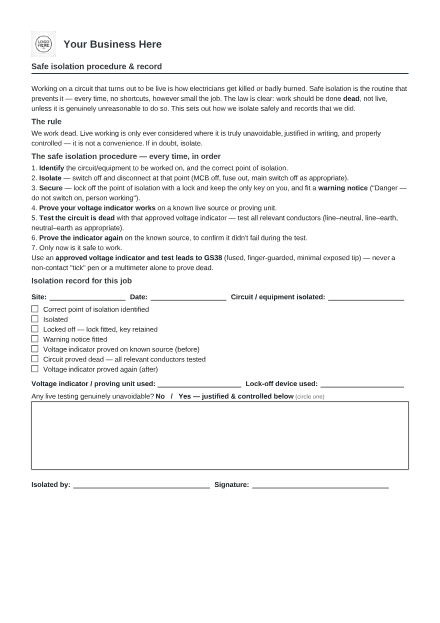
Safe isolation procedure & record
Prove–test–prove, lock off, work dead — the routine that keeps electricians alive.
£14 inc. VAT — yours forever, no subscription.Or get it in the Electrician pack — £34.
Type your business name and the preview updates in seconds — the real PDF, editable on screen or printable to fill in by pen. Nothing about your business leaves your browser.
What you need to know
The plain-English guidance that comes with this document.
- This is the procedure that keeps you alive — treat it as sacred. Electrocution and arc-flash burns from working on supposedly-dead circuits that were actually live are among the most common serious injuries in the trade, and they happen to experienced people on "quick" jobs. The safe isolation sequence exists precisely because assuming a circuit is dead has killed electricians. Do it every time, in full.
- The law says work dead. The Electricity at Work Regulations 1989 require that work on or near electrical equipment is done with it made dead unless it is unreasonable for it to be dead and suitable precautions are taken. Live working is a rare, justified exception — not a way to save five minutes. If you ever do work live, you need a real reason and real controls, which is why this record asks you to justify it.
- Prove–test–prove, with a proving unit — never trust a single test. The heart of safe isolation is proving your voltage indicator works before and after you test the circuit dead, on a known source or proving unit. If you only test once and your indicator had failed, you'd read "dead" on a live circuit. The double-prove is what catches a faulty tester.
- Lock off and keep the key on you. Securing the isolation point with your own lock, and holding the only key, is what stops someone else — a customer, another trade, a family member — switching the supply back on while you've got your hands in the board. A warning notice backs it up. This is non-negotiable on any job where someone else could reach the supply.
- Use GS38 test equipment. Your voltage indicator and leads should meet HSE guidance note GS38 — fused leads, finger guards, minimal exposed metal at the tips. A non-contact voltage "pen" is a useful first indication but must never be used to prove a circuit dead. The right kit is part of the procedure, not an optional extra.
- Record it, especially on commercial and shared sites. On a domestic job the record is good discipline; on a commercial or construction site, where others are around and a permit system may apply, a written isolation record is often expected and is strong evidence you worked safely. Keep them.
- This is the method — adapt the detail to the installation, not the principle. TN-S, TN-C-S and TT systems, single- and three-phase, boards with different isolation arrangements all need the right point of isolation chosen — but the prove–isolate–secure–prove–test–prove discipline never changes.
Please note: This is a template for guidance only. Adapt it to your business and check it against current law and your insurance requirements. It is not legal advice.