
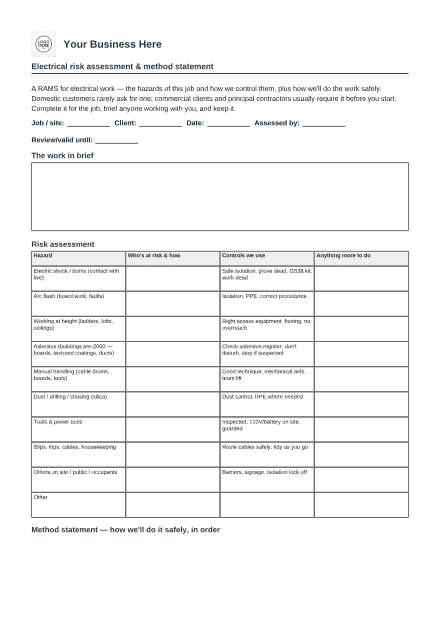
Electrical risk assessment & method statement (RAMS)
The RAMS commercial clients ask for — shock, arc flash, height, asbestos.
£14 inc. VAT — yours forever, no subscription.Or get it in the Electrician pack — £34.
Type your business name and the preview updates in seconds — the real PDF, editable on screen or printable to fill in by pen. Nothing about your business leaves your browser.
What you need to know
The plain-English guidance that comes with this document.
- Commercial work usually won't start without a RAMS — this is your passport onto site. Domestic customers rarely ask, but principal contractors, letting agents, facilities managers and commercial clients almost always require a risk assessment and method statement before you set foot on site. A ready, professional RAMS you can tailor in ten minutes wins and keeps that work.
- The electrician's headline hazard is obvious — but it's not the only one. Electric shock and arc flash are the ones that define the trade, and safe isolation (its own document in this pack) is the main control. But the injuries that actually put electricians in hospital are just as often falls from ladders and lofts, and manual-handling strains from cable drums and boards. Assess the whole job, not just the volts.
- Asbestos is the sleeper in older properties — check before you drill. Any building built or refurbished before 2000 may contain asbestos, and electricians disturb exactly the places it hides: behind boards, in textured "Artex" ceilings, in ducts and around old wiring. Check the asbestos register on commercial sites, and if you find or suspect asbestos, stop — don't drill or break it. Your Safety pack's asbestos and COSHH material backs this up.
- A method statement is you thinking the job through before you're up a ladder. Writing the sequence — survey, isolate, prove dead, do the work, test, re-energise, hand back — forces you to spot the awkward bit in advance (the shared supply, the occupied office, the live board you can't fully isolate). It's as much a planning tool as a compliance document.
- Brief whoever's with you — a RAMS in the van helps no one. Its value is in the briefing. An apprentice, a labourer or another trade working alongside you needs to know the isolation plan and the hazards. Record that you told them.
- Keep it proportionate. A socket swap doesn't need three pages; a commercial rewire in an occupied building does. Scale the detail to the risk, and reuse a good base for similar jobs rather than starting blank each time.
- This supports your professional judgement — it doesn't replace it. You're the competent person. Adapt the hazards and controls to the actual site, and pair this with the safe isolation record and your Safety pack (COSHH, working at height, manual handling) for the full picture.
Please note: This is a template for guidance only. Adapt it to your business and check it against current law and your insurance requirements. It is not legal advice.