
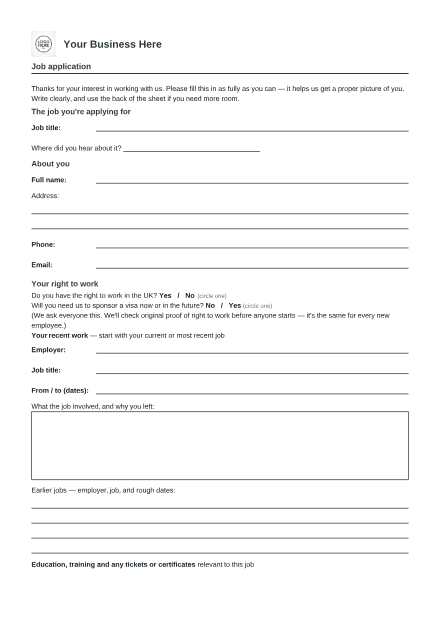
Job application form
A fair application form — no unlawful health or age questions.
£7 inc. VAT — yours forever, no subscription.
Type your business name and the preview updates in seconds — the real PDF, editable on screen or printable to fill in by pen. Nothing about your business leaves your browser.
What you need to know
The plain-English guidance that comes with this document.
- Never ask about health or disability at this stage — it's against the law. Section 60 of the Equality Act 2010 stops you asking health or disability questions before you offer someone the job. That means no "sickness record", no "do you have any medical conditions", no disability questions on the application form or at interview. Once you've made an offer, you can ask what adjustments someone needs. There are narrow exceptions (for example, a question about something genuinely intrinsic to the job), but for most small employers the safe rule is simple: don't ask until you've offered.
- Keep equal-opportunities monitoring separate — and optional. If you want to monitor diversity (age, ethnicity, sex, disability and so on), that's fine, but it must be on a separate sheet, filled in voluntarily, and kept away from the people actually shortlisting. It must never influence who gets the job. Don't put any of it on this form.
- Only ask what you need — this is personal data. Everything on this form is personal data under UK GDPR, so collect only what's relevant to the job and keep it securely. The note at the foot of the form is your short, plain-English privacy line; if you have a fuller applicant privacy notice, point people to it.
- Don't ask about criminal records unless you're genuinely allowed to. For most jobs you can't ask for a DBS check or spent convictions. Certain roles — working with children or vulnerable adults, some licensed trades — are different. If your job isn't one of those, leave convictions off the form.
- Right to work: the question is fine, the check comes later. Asking whether someone can work in the UK, and whether they'll need sponsorship, is allowed and sensible. But don't reject someone just for needing a visa without thinking it through, and remember the actual document check happens before their first day — for everyone, not just some.
- Bin the unsuccessful ones properly, but not too fast. Keep unsuccessful applications only as long as you reasonably need — usually a few months in case of a query or complaint — then dispose of them securely. Holding a drawer full of old applications forever is a data protection risk with no upside.
- Applies UK-wide. The Equality Act 2010 covers England, Wales and Scotland; Northern Ireland has its own equality law with similar protections. UK GDPR applies across the whole UK.
Please note: This is a template for guidance only. Adapt it to your business and check it against current law and your insurance requirements. It is not legal advice.