
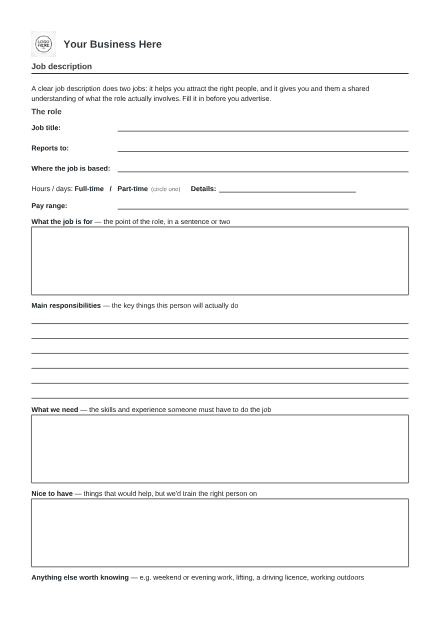
Job description template
Describe a role clearly and fairly before you advertise it.
£4 inc. VAT — yours forever, no subscription.
Type your business name and the preview updates in seconds — the real PDF, editable on screen or printable to fill in by pen. Nothing about your business leaves your browser.
What you need to know
The plain-English guidance that comes with this document.
- Describe the job, not the person you're picturing. Write down what the role needs doing and the skills to do it — not an image of a "young, energetic" someone or a "recent graduate". Asking for things you don't really need (like "5 years' experience" for a job a keen beginner could learn) can quietly screen out good people and, worse, stray into age or other discrimination. Every requirement should be one you could honestly defend as genuinely needed for the job.
- Split "essential" from "nice to have" — and be honest about which is which. Essential means someone genuinely can't do the job without it. Everything else is desirable. Padding the essential list is the single most common way small employers put off exactly the people they'd have been glad to hire.
- Watch the wording for hidden bias. "Strong and fit" when you mean "able to carry stock", "native English speaker" when you mean "clear communication", "recent school leaver" when you just want enthusiasm — these can all be discriminatory. Say what the job actually requires and you'll usually avoid the trap.
- Be careful with driving licences and cars. Only ask for a driving licence if driving is genuinely part of the job — requiring one when it isn't can indirectly discriminate against some disabled people. If you do need someone to get about, "able to travel between sites" is often the fairer test.
- Keep it current and reuse it. A good job description isn't just for hiring — it's the backbone of the induction, the probation review and any later conversation about performance. Save your finished version as a master and tweak it next time, rather than starting from scratch.
- It's not the contract. A job description says what the role involves; the statement of main terms sets the legal terms (pay, hours, holiday, notice). Keep them separate, and avoid promising anything in the job description you're not ready to put in the statement.
- Applies UK-wide. The Equality Act 2010 covers England, Wales and Scotland; Northern Ireland has its own, broadly similar equality law. The fairness points above hold wherever you are.
Please note: This is a template for guidance only. Adapt it to your business and check it against current law and your insurance requirements. It is not legal advice.