
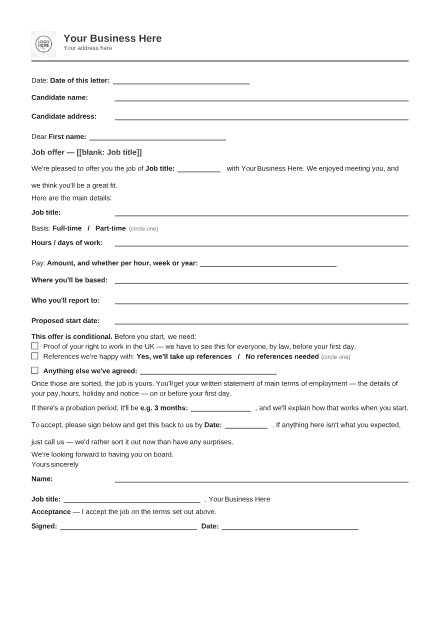
Job offer letter
Make a conditional job offer, done properly.
£7 inc. VAT — yours forever, no subscription.
Type your business name and the preview updates in seconds — the real PDF, editable on screen or printable to fill in by pen. Nothing about your business leaves your browser.
What you need to know
The plain-English guidance that comes with this document.
- Make the offer conditional, in writing, from the start. Say plainly that the offer depends on proof of right to work and on references you're happy with. If you offer unconditionally and then try to pull out, you're on much shakier ground — a clear conditional offer lets you withdraw fairly if a condition isn't met.
- Right to work: check everyone, before day one — no exceptions, no guessing. You must see and verify proof that the person can work in the UK before their first day, for every new starter — not just people you think might need it. Checking only some people (say, by how they look or sound) is itself unlawful discrimination. Get it wrong and the civil penalty is up to £45,000 per illegal worker for a first breach, and up to £60,000 for a repeat. Use the person's share code on the gov.uk online service, an approved digital identity check for British and Irish passport holders, or a manual check of original documents — and keep a copy for as long as they work for you, plus two years after.
- Don't ask about health or disability yet. By law (section 60 of the Equality Act 2010) you generally can't ask health or disability questions before offering the job — so keep them out of the offer stage too. Once you've made the offer, you can ask what reasonable adjustments someone needs to do the job well.
- Spell out the money properly. Say whether the pay is per hour, per week or per year, and make sure any hourly rate is at or above the National Minimum/Living Wage for the person's age — those rates change every April, so check the current figure before you send the letter.
- The statement of main terms is a legal must — and it's due early. Every employee (and worker) has the right to a written statement of the main terms of their employment on or before their first day. Mentioning it in the offer sets the expectation; use your Statement of main terms document to actually provide it.
- Keep a copy of the signed acceptance. It's your proof of what was agreed and when. File it with their other records once they start.
- UK-wide, with one date to watch. The right-to-work duty and the offer points above apply across the UK. Note that from January 2027 the qualifying period for ordinary unfair dismissal in Great Britain drops to six months (it was two years), so a new starter builds up that protection far sooner than before — a fair, well-recorded recruitment and probation process matters more than ever. Northern Ireland keeps its own one-year qualifying period.
Please note: This is a template for guidance only. Adapt it to your business and check it against current law and your insurance requirements. It is not legal advice.