
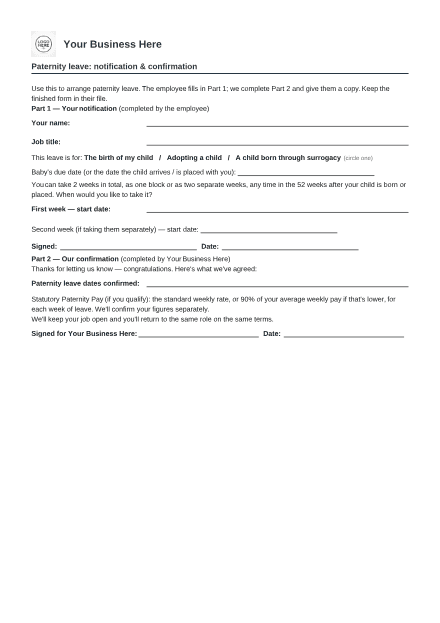
Paternity leave notification & confirmation
Arrange paternity leave — now a day-one right.
£7 inc. VAT — yours forever, no subscription.
Type your business name and the preview updates in seconds — the real PDF, editable on screen or printable to fill in by pen. Nothing about your business leaves your browser.
What you need to know
The plain-English guidance that comes with this document.
- It's now a day-one right — no service needed for the leave. Since 6 April 2026, paternity leave is available from an employee's first day; the old requirement of 26 weeks' service was removed. (Statutory paternity pay still has a service and earnings test, so someone can qualify for the leave but not the pay.) The leave is for the father, the mother's partner, or a parent through adoption or surrogacy.
- Two weeks, and they can now split it. The entitlement is 2 weeks. Under the rules that changed in 2024, those two weeks can be taken as two separate one-week blocks rather than in one go, and at any point in the 52 weeks after the birth or placement — much more flexible than the old "within 56 days" rule. They can't take odd days, though: it's whole weeks.
- Notice: the entitlement early, the dates later. For a birth, an employee should tell you they intend to take paternity leave by the 15th week before the baby's due (the same qualifying week as maternity), and then give you 28 days' notice of the actual dates they want off. For adoption the timing runs from when they're matched. This form captures both the plan and the confirmation.
- The pay, in plain terms. Statutory Paternity Pay is the flat weekly rate (£194.32 from April 2026) or 90% of average weekly earnings if lower, for each week taken. As with maternity, you can usually reclaim most of it from HMRC. The rate changes every April — check the current figure.
- Don't penalise them for taking it. Paternity leave is a legal right. Someone shouldn't lose out on hours, pay or opportunities for using it — treating them worse for taking family leave risks a discrimination or detriment claim.
- There's more leave they might be entitled to. A partner may also be able to take Shared Parental Leave (sharing the mother's leave and pay) or, if the baby needs neonatal care, the newer Neonatal Care Leave. Those are separate schemes — mention them if it comes up, and point the employee to gov.uk for the detail.
- Applies UK-wide, with a caveat. Paternity leave and pay apply across the UK. The day-one change is a Great Britain reform (England, Wales, Scotland); Northern Ireland sets its own employment law, so if you're in NI, check whether and when the same day-one right applies there.
Please note: This is a template for guidance only. Adapt it to your business and check it against current law and your insurance requirements. It is not legal advice.