
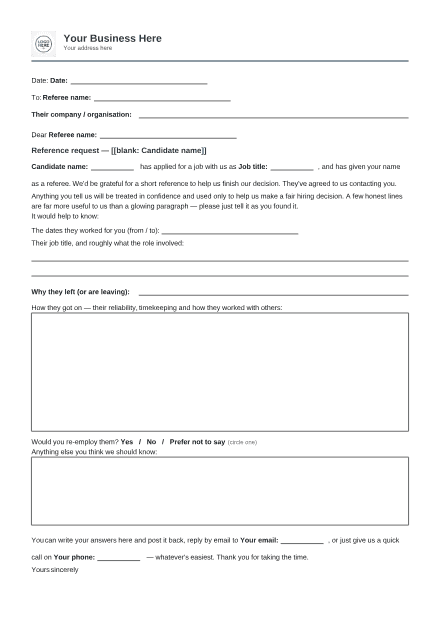
Reference request letter
Ask a candidate's former employer for a reference.
£4 inc. VAT — yours forever, no subscription.
Type your business name and the preview updates in seconds — the real PDF, editable on screen or printable to fill in by pen. Nothing about your business leaves your browser.
What you need to know
The plain-English guidance that comes with this document.
- Get the candidate's agreement first. Ask before you contact anyone, and take up references only for the person you're actually offering the job to — not every applicant. Contacting someone's current employer before they've accepted can land them in hot water, so check they're happy for you to approach each referee.
- Stick to fact, and keep it fair. When you're the one being asked for a reference, the law expects it to be true, accurate and not misleading — you can be sued by either the worker or the new employer if it's carelessly wrong. The same is true of whoever you're asking, so weigh what you get: a vague or oddly guarded reference can tell you as much as a detailed one.
- A bare "dates and job title" reference is normal now. Many employers, especially larger ones, will only confirm the dates someone worked and their job title — they're being cautious, not cagey. Don't read too much into it. If you want more, a friendly phone call sometimes gets you a fuller, franker picture than a form ever will.
- Handle the reply as personal data. A reference is personal data about the candidate, so keep it secure and use it only to make your decision. Be aware the candidate can, in many cases, ask to see what was written about them — so nothing should be in there you couldn't stand behind.
- Don't ask about health — even now. You still can't use the reference stage to fish for health or sickness-absence information before a job offer (section 60 of the Equality Act 2010). Asking a former employer "how many days were they off sick?" before you've offered the job is exactly the kind of question that rule is there to stop. Confirm the job offer first, then deal with any genuine health or attendance matters properly and fairly.
- Make your offer conditional so a poor reference isn't a trap. If your job offer says it's subject to satisfactory references, an honest but worrying reference gives you room to pause and talk it through — rather than being stuck because you offered unconditionally. Your Job offer letter is set up to do exactly this.
- Applies UK-wide. The duty to give a fair and accurate reference, and the data protection and Equality Act points above, apply across the UK.
Please note: This is a template for guidance only. Adapt it to your business and check it against current law and your insurance requirements. It is not legal advice.