
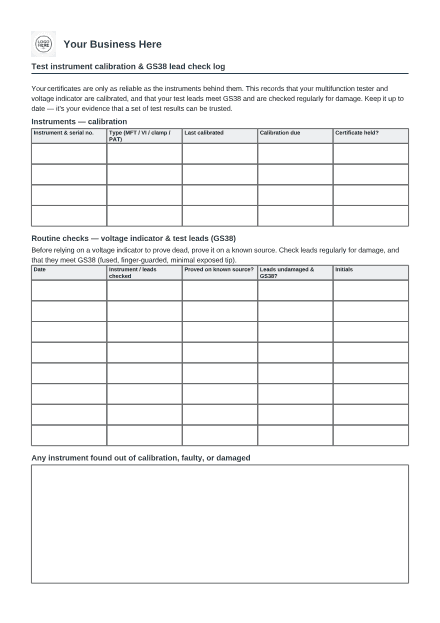
Test instrument calibration & GS38 lead check log
Calibrated instruments and safe leads — what makes your certificates trustworthy.
£4 inc. VAT — yours forever, no subscription.Or get it in the Electrician pack — £34.
Type your business name and the preview updates in seconds — the real PDF, editable on screen or printable to fill in by pen. Nothing about your business leaves your browser.
What you need to know
The plain-English guidance that comes with this document.
- A certificate from an uncalibrated meter is worth very little — this log protects all of them. Your EICs, minor works and EICRs stand on the readings your instruments give. If a tester drifts out of accuracy, every result it produced is in doubt. Regular calibration, recorded here, is what lets you (and anyone challenging your work) trust the numbers. Most electricians calibrate their multifunction tester annually and keep the certificate.
- Between calibrations, check the instrument still agrees with itself. Calibration is a once-a-year lab job; the everyday habit is a quick "does it still read right?" check against known values or a proving unit. It catches a meter that's been dropped or has drifted before it puts a bad reading on a certificate.
- GS38 leads are a safety item, not just an accuracy one. Your voltage indicator and test leads are what stand between you and a live conductor. GS38 (the HSE guidance) calls for fused leads, finger guards and minimal exposed metal at the tips — worn or cracked leads with too much bare tip can arc or let you bridge across terminals. Check them for damage regularly and bin damaged ones; this log records that you do.
- Prove your voltage indicator every time you use it to prove dead. The single most important routine check is proving your voltage indicator works on a known live source or proving unit before and after you test a circuit dead (see the safe isolation record). A dead reading from a failed indicator is how people get hurt — the proving step is what catches it.
- If an instrument fails, act on the jobs behind it. An out-of-calibration or faulty tester isn't just a kit problem — you may need to consider the certificates it produced since it last read true. Withdraw it, note it here, and decide whether any recent results need re-checking. That honesty protects you and your customers.
- Keep your calibration certificates with this log. The log is the index; the calibration certificates from the lab are the proof. Together they're a tidy answer to "how do I know your test results are valid?" — a question that comes up in disputes, insurance claims and larger commercial work.
Please note: This is a template for guidance only. Adapt it to your business and check it against current law and your insurance requirements. It is not legal advice.