
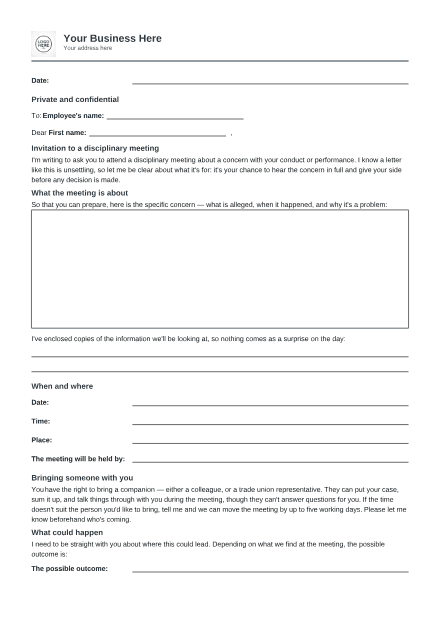
Invite to a disciplinary meeting
A fair, clearly-worded letter inviting someone to a disciplinary meeting.
£7 inc. VAT — yours forever, no subscription.Or get it in the HR Plus pack — £39.
Type your business name and the preview updates in seconds — the real PDF, editable on screen or printable to fill in by pen. Nothing about your business leaves your browser.
What you need to know
The plain-English guidance that comes with this document.
- Why this letter is worth getting right. Disciplinary processes are judged against the Acas Code of Practice. If it ever reaches a tribunal and you've unreasonably ignored the Code, they can add up to 25% to the award against you — and following it properly can cut an award by the same. This letter is built around that Code, but the care you take filling it in is what actually protects you.
- Be specific — "a bad attitude" won't do. The single most common mistake is a vague allegation. Spell out exactly what's alleged, when it happened, and which rule or standard it falls short of. If the person can't tell from your letter what they're supposed to answer, the whole process is on shaky ground.
- Show your cards — enclose the evidence. Send copies of anything you'll rely on (witness notes, till reports, messages) with the letter. Ambushing someone with documents they've never seen at the meeting is exactly the kind of thing that makes a dismissal unfair.
- Give them real time to prepare. Hold the meeting promptly, but not so fast they can't get ready — a couple of clear days is a sensible minimum. Same-day "come to my office now" disciplinaries are asking for trouble.
- The companion right is a legal one, not a courtesy. If they ask to bring a colleague or union rep and that person can't make your date, you must offer to move the meeting by up to five working days. Don't refuse a reasonable request to be accompanied.
- State the worst realistic outcome honestly. If what's alleged could get them dismissed — gross misconduct like theft, violence or a serious safety breach — you must say dismissal is a possible outcome in the letter. Spring dismissal on someone who was told it was "just a chat" and the dismissal is likely unfair. If it's a first minor issue, say so (for example, "a first written warning").
- Go in with an open mind. A disciplinary meeting is not a formality on the way to a decision you've already made. If your mind's made up before you've heard them, it isn't a fair hearing — and it can look that way to a tribunal.
- Suspension is not a punishment. If you need to suspend someone while you look into things, keep it as short as possible, keep them on full pay, and tell them in writing that it's not a disciplinary sanction and doesn't assume guilt.
- Could a quiet word do instead? The Code encourages sorting minor things informally first. Not every problem needs the formal machinery — sometimes an honest conversation fixes it faster and keeps the relationship intact. Save this letter for when informal steps haven't worked or the matter is genuinely serious.
- What comes next. After the meeting, put your decision in writing and tell them they have the right to appeal, and to whom. (An outcome-and-appeal letter is a natural companion to this one if you'd like it added to the pack.)
- Scotland is the same; Northern Ireland is genuinely not. In England, Wales and Scotland the Acas Code above applies. Northern Ireland is different in a way that catches people out: it kept the statutory disciplinary and dismissal procedures that Great Britain scrapped, set out in the LRA Code of Practice (not Acas). If you're in NI and you skip the statutory steps, a dismissal is treated as automatically unfair, and awards can be adjusted by up to 50%. NI employers should follow the LRA Code and take local advice before dismissing.
- Keep it locked down. This letter and everything around the case is sensitive personal and conduct data — store it securely in the employee's file, and share it only with people who genuinely need to see it.
Please note: This is a template for guidance only. Adapt it to your business and check it against current law and your insurance requirements. It is not legal advice.