
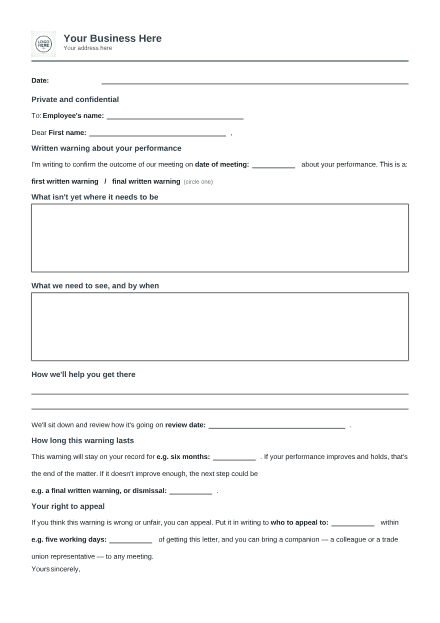
Written warning (performance)
A capability warning for someone falling short — not a dismissal.
£7 inc. VAT — yours forever, no subscription.Or get it in the HR Plus pack — £39.
Type your business name and the preview updates in seconds — the real PDF, editable on screen or printable to fill in by pen. Nothing about your business leaves your browser.
What you need to know
The plain-English guidance that comes with this document.
- This is for performance, not misconduct — keep the two apart. Use this when someone is genuinely trying but not meeting the standard (capability). If the problem is deliberate — bad behaviour, breaking rules, dishonesty — that's misconduct, and you use your disciplinary invite, meeting note and outcome letters instead. Mixing them up is unfair and confusing.
- Have the conversation before you write the warning. A written performance warning shouldn't be the first someone hears of a problem. Fair process is: raise it clearly, meet to talk it through, agree what needs to improve, give real support and a realistic timescale, then review. This letter confirms a step in that process — it doesn't replace it.
- Be specific and measurable. "Buck your ideas up" gives someone nothing to aim at. Spell out exactly what's falling short, with examples, and what "good enough" looks like — ideally something you can both measure. Vague standards make a later dismissal look unfair.
- Offer genuine help, and a fair amount of time. Training, closer supervision, a mentor, or adjustments — show you've tried to help them succeed. If poor performance might be linked to a health condition or disability, think about reasonable adjustments before you reach for a warning.
- Work up the steps. Performance is usually managed in stages — a first written warning, then (if needed) a final written warning, then dismissal — with a proper review at each stage. Don't jump to the end unless the situation is exceptional.
- Be clear how long the warning lives, and don't lean on a dead one. State how long it stays on file, and once it's expired, treat it as spent — you can't stack an old lapsed warning onto a new issue.
- Always offer an appeal. Performance cases are judged against the Acas Code just like conduct — unreasonably ignoring it can add up to 25% to a tribunal award. An appeal, heard with an open mind, is part of getting it right.
- Keep it secure. This letter is sensitive personal data about someone's work — store it in their file, seen only by those who need it.
- Scotland is the same; Northern Ireland runs its own statutory process. The Acas approach applies in England, Wales and Scotland. In Northern Ireland the statutory procedure under the LRA Code applies, and skipping its steps can make a later dismissal automatically unfair — see the guidance on your disciplinary letters.
Please note: This is a template for guidance only. Adapt it to your business and check it against current law and your insurance requirements. It is not legal advice.