
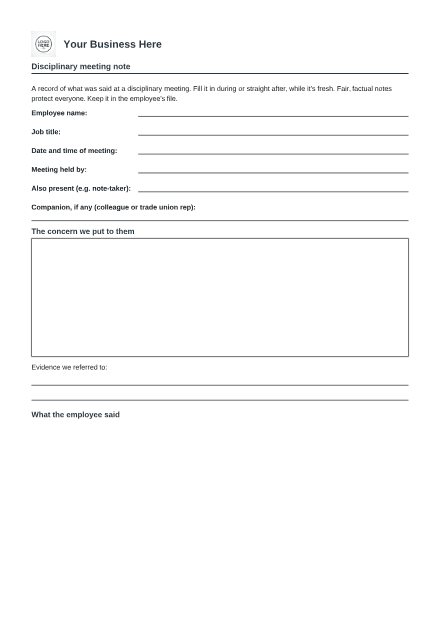
Disciplinary meeting note
A fair, contemporaneous record of what was said at the meeting.
£7 inc. VAT — yours forever, no subscription.Or get it in the HR Plus pack — £39.
Type your business name and the preview updates in seconds — the real PDF, editable on screen or printable to fill in by pen. Nothing about your business leaves your browser.
What you need to know
The plain-English guidance that comes with this document.
- Write it down at the time — memory won't cut it. A fair, contemporaneous note of a disciplinary meeting is one of the first things a tribunal asks to see. Take notes as you go, or straight after; don't reconstruct it a week later from memory.
- Record what was said, not what you thought of it. Stick to the facts — who said what, what was shown, what was agreed. Your opinions and conclusions belong in the decision afterwards, not in the record of the meeting.
- Let them have their full say. The whole point of the meeting is to hear their side before you decide (that's what your invite letter promised). If they raise something new or plausible, take it seriously — which often means pausing.
- Adjourn rather than deciding on the spot. If new points come up that need checking, adjourn, look into them, and reconvene. Deciding an outcome in the room when you still have questions is how fair processes come unstuck.
- The decision comes later, in writing. Don't announce the outcome at the end of the meeting if you need time to weigh it up. It goes in the outcome and appeal letter once you've properly considered everything.
- The companion has a defined role. A colleague or union rep can put and sum up the person's case and confer with them, but can't answer questions on their behalf. Let them do their bit without taking over the meeting.
- Offer them a copy, and respect disagreement. Give the employee a copy of these notes. If they think the notes are wrong, record their point rather than pressing them to sign something they don't accept.
- Keep it locked down. These notes are sensitive conduct data — store them securely in the employee's file, seen only by those who need to.
- Scotland is the same; Northern Ireland runs its own statutory process. The Acas approach applies in England, Wales and Scotland. In Northern Ireland the statutory disciplinary procedure under the LRA Code applies instead, and skipping its steps can make a dismissal automatically unfair — see the guidance on your disciplinary invite letter.
Please note: This is a template for guidance only. Adapt it to your business and check it against current law and your insurance requirements. It is not legal advice.