
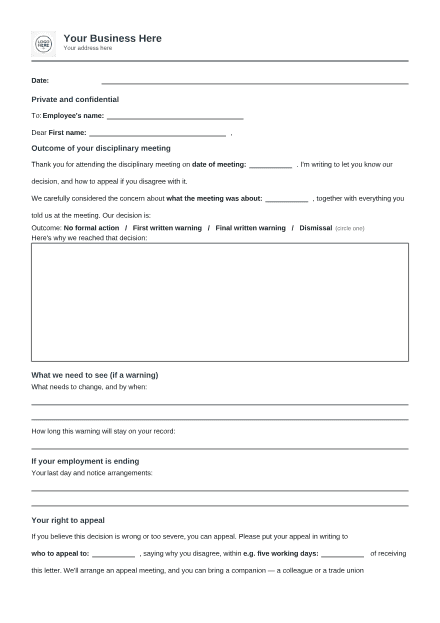
Disciplinary outcome and appeal letter
Put the decision in writing, with reasons and the right to appeal.
£7 inc. VAT — yours forever, no subscription.Or get it in the HR Plus pack — £39.
Type your business name and the preview updates in seconds — the real PDF, editable on screen or printable to fill in by pen. Nothing about your business leaves your browser.
What you need to know
The plain-English guidance that comes with this document.
- Get the decision in writing, and reasonably quickly. After the meeting, put the outcome in writing without unreasonable delay. A clear decision letter with reasons is the other half of a fair process — the invite opens it, this closes it.
- The outcome must match what you warned was possible. You can only dismiss if you told them at the invite stage that dismissal was a possible outcome. Landing a heavier sanction than you flagged is a classic way to turn a fair case into an unfair dismissal.
- Spell out the reasons — don't be vague. "Your conduct fell short" isn't enough. Say what you decided, on what evidence, and why. If it ever gets tested, the reasons in this letter are what you'll stand on.
- Warnings: say what must change, and how long they last. State clearly what improvement you expect and by when, and how long the warning stays live. There's no fixed legal period — a first written warning commonly lasts around six months and a final around twelve — but set your own policy, be consistent, and don't rely on a warning that has expired.
- Dismissal: get the notice right. Unless it's genuine gross misconduct (where dismissal can be without notice), you must give the notice set out in their statement of main terms, or pay in lieu if their contract allows it. Be sure gross misconduct really qualifies before dismissing on the spot.
- The right of appeal isn't optional. Always offer an appeal, say who to and by when, and — ideally — have someone who wasn't involved hear it. Going into the appeal with a genuinely open mind is the point; a rubber-stamp appeal is worse than none.
- Keep it secure. This letter and the whole case are sensitive conduct data — store securely in the employee's file, shared only with those who need it.
- Scotland is the same; Northern Ireland is not. The Acas approach applies in England, Wales and Scotland. Northern Ireland keeps its own statutory disciplinary and dismissal procedure under the LRA Code — skip its steps and a dismissal is automatically unfair, with awards adjustable by up to 50%. NI employers should follow the LRA Code and take local advice.
Please note: This is a template for guidance only. Adapt it to your business and check it against current law and your insurance requirements. It is not legal advice.