
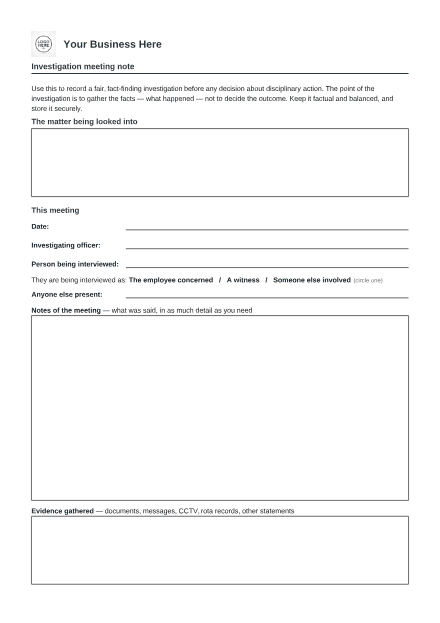
Investigation meeting note
Record a fair fact-finding investigation before any disciplinary.
£7 inc. VAT — yours forever, no subscription.Or get it in the HR Plus pack — £39.
Type your business name and the preview updates in seconds — the real PDF, editable on screen or printable to fill in by pen. Nothing about your business leaves your browser.
What you need to know
The plain-English guidance that comes with this document.
- Investigate before you accuse — the Acas Code expects it. Before anyone faces a disciplinary hearing, you must carry out a reasonable investigation to establish the facts. Skipping this step, or going through the motions, is one of the most common reasons a later dismissal is found unfair. How much investigation is "reasonable" depends on the seriousness — but there must be a genuine one.
- Keep the investigator and the decision-maker apart where you can. Ideally the person who investigates isn't the same person who then chairs the disciplinary hearing and decides the outcome. In a very small business that isn't always possible — if one person has to do both, be scrupulously fair, keep an open mind, and record your reasoning so it's clear you didn't prejudge.
- An investigation meeting is not a disciplinary hearing. It's fact-finding, so the statutory right to be accompanied doesn't automatically apply (though allowing it can be sensible and fair). Don't let a fact-find turn into an ambush — be clear with the person why you're meeting, and give them a fair chance to explain.
- Gather both sides, and the paperwork. Collect the evidence that helps the employee as well as the evidence against them — a one-sided investigation is a flawed one. Note where messages, CCTV, rotas or witness statements are kept, and preserve them; don't let CCTV overwrite or messages get deleted.
- Move quickly and keep it confidential. Memories fade and suspensions shouldn't drag, so investigate promptly. Share what you find only with those who need it, and store this note securely — it's personal data, and often sensitive.
- The recommendation isn't the verdict. This note ends with a recommendation about whether there's a case to answer — not a decision to discipline. If it goes forward, the decision is made at the disciplinary hearing, after the employee has heard the case and responded. Keep those two steps genuinely separate.
- Applies UK-wide, with the NI caveat. The investigate-first principle applies across the UK. The Acas Code governs the process in England, Wales and Scotland; Northern Ireland follows the LRA Code and its statutory dismissal procedures — check the NI position if that's where you are.
Please note: This is a template for guidance only. Adapt it to your business and check it against current law and your insurance requirements. It is not legal advice.