
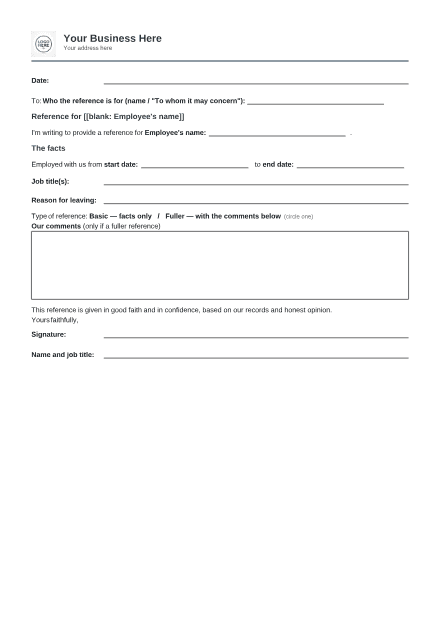
Employee reference
A fair, fact-first reference for a departing or former employee.
£7 inc. VAT — yours forever, no subscription.Or get it in the HR Plus pack — £39.
Type your business name and the preview updates in seconds — the real PDF, editable on screen or printable to fill in by pen. Nothing about your business leaves your browser.
What you need to know
The plain-English guidance that comes with this document.
- You usually don't have to give one — but if you do, it has to be fair. For most jobs there's no legal duty to give a reference (some regulated sectors are an exception). But once you choose to, the law expects it to be true, accurate, fair and not misleading. Get that wrong and you can be sued by the new employer and by the former employee — so a throwaway line can cost you.
- When in doubt, keep it basic. The safest reference is just the facts: job title and dates of employment. Loads of businesses have a firm policy of giving only that, precisely because opinions carry risk. There's no shame in it, and it's completely fair.
- If you give an opinion, be able to prove it. Only say things you could back up from your records — appraisals, your training and absence records, that sort of thing. Don't repeat unproven allegations, and leave out any disciplinary matter that has expired.
- Treat everyone the same. Give the same kind of reference for people in similar situations. Deliberately giving a poor or bare reference to punish someone — for example because they raised a grievance — can be victimisation, which is a claim in itself.
- Be very careful with sickness and disability. Don't spell out someone's health history or absence record in a way that could let a new employer discriminate. If you're asked about absence, take advice before answering — it's a common trap.
- Mark it confidential, and mean it. Address it properly, say it's given in confidence, and send it directly to the person who asked — not via the employee. Keep a copy on file.
- A note on data protection. A reference is personal data. There are some special rules about references (the version you write has limited exemptions from being disclosed), but assume what you write could be seen — so write nothing you couldn't stand behind.
- Same principles across the UK. The fairness, accuracy and discrimination rules apply throughout England, Wales, Scotland and Northern Ireland — the underlying statutes differ in NI, but the practical approach is identical.
Please note: This is a template for guidance only. Adapt it to your business and check it against current law and your insurance requirements. It is not legal advice.